

Exploring Scotland: Castles, Highlands, History and Our Road Trip Through the Country

Updated: Aug 26
Back in 2019, before Closer Lives existed, before the full-time travel lifestyle, before the YouTube channel and hundreds of blog posts, Scotland formed part of our very first road trip together.
What started as an impromptu weekend getaway quickly became something much more important. It was our first real adventure as a couple and the trip that helped shape the life we would eventually build.

From the quaint ancient alleys of Edinburgh to the wide-open vistas of the Cairngorms and the legendary waters of Loch Ness, Scotland showed us why it still captures the imagination of travelers the world over.
What we found was a country where history is alive, where every castle has its own story to tell, and where even a roadside view can be an amazing experience.
In this post, we share our route, our highlights, practical planning advice, and the experiences that stood out most to us.
If you are considering a Scotland road trip of your own, this guide will help you discover some of the places that made our journey so memorable.

Key Takeaways
● At a glance: Our route covered Edinburgh, six castles, the Cairngorms, Loch Ness and several unplanned Highland viewpoints.
● Our experience: The unexpected Moment in Time viewpoint and atmospheric Inverlochy Castle became two of the strongest memories from our first road trip together.
● The route: The journey began in Edinburgh and continued north through the Cairngorms to Urquhart Castle and Inverlochy Castle.
In This Post...
See More...
Our Highlights

Our journey took us through the wild heart of the Cairngorms National Park, inside the gates of an iconic royal residence, and across the thresholds of six magnificent castles.
While every stop was pretty epic, a surprise viewpoint at the Moment in Time Monument and the raw romance of Inverlochy Castle completely stole the show.
Edinburgh Castle
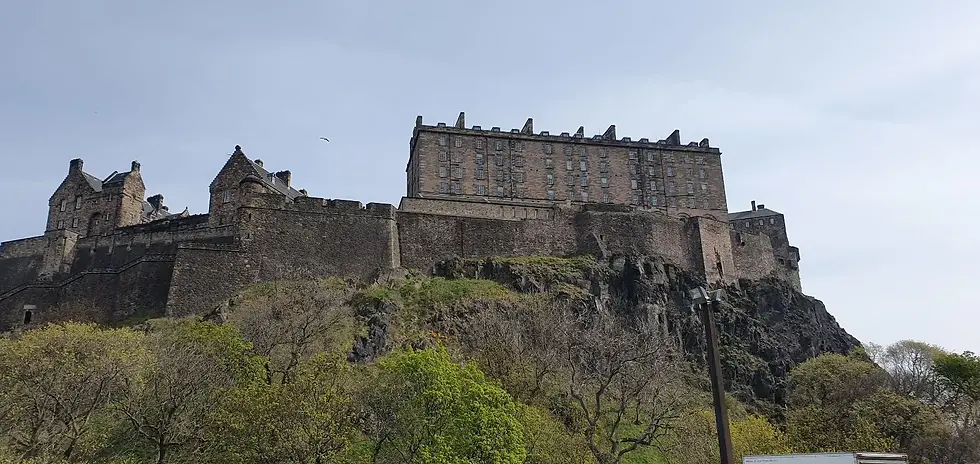
Perched on top of an ancient volcanic rock high above Scotland’s capital, Edinburgh Castle was an immediate reminder of why it remains one of the country’s most popular attractions.
With the Crown Jewels, military history, spectacular city views, and even a 'pet' cemetery, it was a perfect introduction to Scotland's rich history and a dramatic start to our journey north.
Rosslyn Castle

Rosslyn Castle ended up being one of our favorite off-the-radar finds of the trip, overshadowed a bit by its more famous chapel neighbor.
The ruins are situated above a tranquil, heavily wooded river valley; it was a wonderfully atmospheric, peaceful escape that felt totally removed from the modern world.
Braemar Castle

Deep in the Cairngorms National Park, Braemar Castle offered a fascinating, tactile insight into the turbulent history of the Highlands.
It may lack the sprawling grandeur of some of the larger forts in the country, but the distinctive star-shaped defensive wall and rugged setting made it a memorable, intimate stop on our drive.
A cool note is that we saw the castle before its long-awaited recent restoration, adding an extra element to this travel memory!
Balmoral Castle

Balmoral Castle has few rivals for British historical associations. The estate offers a fascinating insight into Scotland’s royal connections, perfectly situated among dramatic mountain scenery and towering pine forests.
Walking the grounds, you can see why this peaceful Highland sanctuary remains one of the country’s most iconic residences.
We inadvertently visited on Easter Sunday, arriving moments before the then Prince Charles arrived for mass. What were the chances?
The Moment in Time Monument

Sometimes, the smallest (and often unplanned) stops leave the biggest impression. High in the Cairngorms, Corgarff Viewpoint offered extraordinary views across the landscape and became one of the most unexpectedly meaningful moments of our entire road trip.
The viewpoint overlooks Corgarff Castle and is home to The Moment in Time Monument, a stone monolith adorned with beautiful poetry.
Given we met through our poetry... this one plants itself firmly in the 'you couldn't make it up' file for us!
Cairngorms National Park

Driving through the Cairngorms National Park genuinely felt like traveling through another world.
The endless mountain scenery, quiet valleys, rolling heather-covered hills, and dramatic landscapes made this easily one of the most beautiful and rewarding sections of our journey.
There are a few ear pops as you travel through the seemingly endless elevations and declines, so pack some anti-nausea tablets if you suffer with that issue.
Urquhart Castle

Urquhart Castle stands on one of Scotland’s most dramatic landscapes, beside the dark, fabled waters of Loch Ness, home to centuries of dramatic clan conflict.
Few ruins anywhere in the country can match the scale of the views from its ancient, weathered towers.
We did not catch a sight of Nessie, but the replica trebuchet was a welcome bonus!
Inverlochy Castle

Our final castle stop brought our Scotland road trip to a perfect, poetic conclusion.
Although heavily ruined and weathered by the centuries, Inverlochy Castle sits majestically beside the River Lochy, one of the few castles in the UK to retain its original form.
Standing beneath the massive shadow of Ben Nevis, it felt like a raw, untamed slice of history completely off the beaten path.
We were able to fully explore the site, although since our visit, the internal courtyard has been closed due to safety concerns. It is still totally worth a tour of the outside, though, and a nice river walk too.
Our Scotland Route
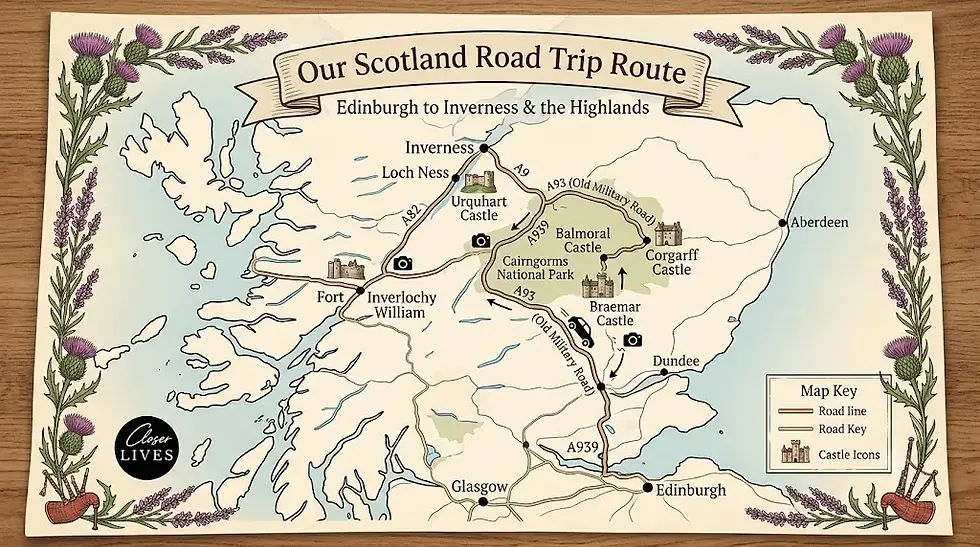
Our road trip took on a natural rhythm as we made our way towards Inverness, which was our end goal before heading home.
After exploring Edinburgh and its nearby landmarks, we ventured into the wild heart of the Cairngorms National Park.
We followed the scenic Highland roads, chiefly the Old Military Road (A93) and the winding A939, through Braemar, Balmoral, and Corgarff, pulling over every few minutes to just stare at the landscapes and snap a quick photo.
Pushing further north along the A9 brought us to Loch Ness and the striking ruins of Urquhart Castle before we eventually turned west onto the iconic A82 toward Fort William and Inverlochy Castle.
What blew us away most was how quickly Scotland changes. In just a few hours, you can leave a bustling historic city behind and find yourself in a remote mountain valley without another soul in sight.
The History of Scotland
Scotland's history spans millennia and is rich with tales of monarchs, clans, conflicts, and cultural milestones.
In prehistoric times, early inhabitants established themselves in the land, creating stone circles and burial sites and leaving behind archaeological evidence that remains visible today.
The Kingdom of Scotland emerged in the early medieval period, steadily consolidating power under a series of rulers. During the Middle Ages, Scotland often engaged in conflicts with its neighboring country, England.
One of the most renowned periods occurred during the Wars of Scottish Independence in the late 13th and early 14th centuries. Figures like William Wallace and Robert the Bruce emerged as national heroes during Scotland's struggle to maintain its sovereignty.
The Battle of Bannockburn in 1314 stands as a pivotal moment in Scottish history, playing a crucial role in securing Scotland's independence for generations.
In 1603, the crowns of Scotland and England were united when James VI of Scotland ascended to the English throne. A century later, the Acts of Union officially brought the two countries together under one parliament.
The Highlands underwent significant transformation during the Jacobite uprisings of the 17th and 18th centuries. The final defeat at the Battle of Culloden in 1746 marked the conclusion of the Jacobite cause and irrevocably altered Highland society.
Castles, towns, battlefields, and landscapes in Scotland still tell the stories of those extraordinary centuries, making it one of the most fascinating places in Europe to visit if you're interested in history.
10 Interesting Facts About Scotland

1. Scotland has more than 2,000 castles: From royal palaces to remote ruins, Scotland contains one of the highest concentrations of castles in the world. We only managed to clear six of them off our list on this trip, which means we officially have 1,994 reasons to come back!
2. Edinburgh was the world's first UNESCO City of Literature: The city has produced some of the world's most celebrated writers, including Sir Walter Scott, Robert Louis Stevenson, and Sir Arthur Conan Doyle.
Walking through the misty, atmospheric alleys of the Old Town, it takes about five minutes to realize exactly where they got their moody, gothic inspiration.
3. Not just about monsters: Loch Ness contains more water than all lakes in England and Wales combined, reaching depths of more than 230 meters.
It’s so massive and deep that it could easily hide a legendary prehistoric creature. (And no, we didn't spot her, but we definitely stared at the water long enough to try).
4. The unicorn is Scotland's national animal: A mythical creature may seem unusual, but it has represented purity, strength, and independence in Scottish heraldry for centuries.
It was chosen as a proud, untamable counterpart to England's lion. Plus, let's be honest, having a mythical beast as your national symbol is just an elite flex!
5. The Cairngorms is the UK's largest national park: The park covers over 4,500 square kilometers of mountains, forests, rivers, and wildlife habitats. Driving through it felt like entering a different world entirely.
We found ourselves pulling over every few minutes just to stare at the endless rolling hills and to make sure that we weren't dreaming!

6. Scotland has more than 790 islands: Only around 90 of these islands remain permanently inhabited. That leaves 700 islands completely free for anyone looking to escape society and start their own off-grid kingdom. Tempted?
7. Golf originated in Scotland: The modern game developed on Scotland's coastal links courses during the Middle Ages. While we do not golf, it is easy to see how a sport about hitting things into the wind was born here.
8. Edinburgh Castle sits on an extinct volcano: Castle Rock was formed millions of years ago through volcanic activity. It provides an incredibly dramatic backdrop for a fortress and an incredible vantage point for the castle itself.
9. Ben Nevis is the highest mountain in the United Kingdom: The summit reaches 1,345 meters above sea level. We caught our final views of it while exploring the ruins of Inverlochy Castle.
Seeing its snow-dusted peak looming over the landscape was the ultimate way to wrap up our journey.
10. Scotland has its own distinct legal system: Despite being part of the United Kingdom, Scotland maintains a separate legal system and educational structure.
This includes their famous third court verdict: "not proven." It essentially means "We think you did it, but we can't prove it."
Nicknamed the "bastard verdict" by Sir Walter Scott, Scotland was the only country in the world to use it until they officially abolished it in January 2026, after almost 300 years, moving to the standard "guilty or not guilty" system.
Best Time to Visit Scotland
Spring (March to May)
Spring brings blooming landscapes, fewer crowds, and longer daylight hours. Temperatures typically range between 7°C and 15°C.
Summer (June to August)
Summer offers the longest days and generally the warmest weather. This is the busiest tourism season, particularly around Edinburgh and the Highlands.
Autumn (September to November)
Autumn colors transform the Highlands into a spectacular display of gold, orange, and red. Visitor numbers also begin to decline.
Winter (December to February)
Winter creates an entirely different atmosphere, with snow-covered mountains and festive celebrations. Weather can be unpredictable, particularly in the Highlands.
How to Get There
Most international visitors arrive via Edinburgh Airport or Glasgow Airport. Scotland is easily accessible from across the United Kingdom and internationally, with major airports, rail connections, and road networks linking the country to the rest of Europe.
By Air
The main international gateways are Edinburgh Airport and Glasgow Airport, both of which offer direct flights from destinations across Europe, North America, and beyond.
Smaller regional airports such as Inverness, Aberdeen, and Dundee provide convenient access to specific parts of the country.
By Train
Scotland's rail network connects major cities, including Edinburgh, Glasgow, Inverness, Aberdeen, and Fort William.
Travellers arriving from England can take direct services from London, Manchester, Newcastle, and other major cities, with the scenic routes through the Highlands being attractions in their own right.
By Car & Car Rental
Scotland's road network is generally excellent, connecting major routes like the M8, A9, and A82.
One of the things we loved most about exploring Scotland was the flexibility that came with having our own vehicle; some of our absolute favorite memories came from unplanned stops along quiet roads and castles we stumbled upon completely by accident.
If you want that same freedom to pull over and explore, we highly recommend renting a vehicle for your journey.
You can compare prices and find the best option through our trusted partner below.
By Cruise Ship
Many travellers also visit Scotland as part of a cruise itinerary. Popular ports include Edinburgh (South Queensferry), Invergordon, Greenock, and Aberdeen, providing access to both Scotland's cities and Highland landscapes.
Where to Stay
Planning your bases is the secret to a great Scotland road trip. We broke our journey down into a few distinct regions to balance city exploring with wild Highland scenery.
Here are the best hubs to base yourself:
Edinburgh (The Perfect Starting Hub)
Ideal for your first couple of nights. It serves as a brilliant base for exploring Scotland's capital, taking in the historic attractions, and acclimating before you hit the open road.
Cairngorms (The Nature Escape)
Perfect for travelers looking to slow down and experience mountain scenery, wildlife, and outdoor adventures. Staying inside puts you right on the doorstep of stunning castles like Braemar and Balmoral.
Inverness (The Highland Capital)
An excellent, central base for exploring the legendary Loch Ness, walking the ruins of Urquhart Castle, and accessing the rugged landscapes of the northern Highlands.
Fort William (The Adventure Finish)
A convenient, highly scenic base at the western end of the route. It's perfectly positioned for visiting Ben Nevis, exploring Glen Coe, and checking out the atmospheric ruins of Inverlochy Castle.
Tips for Visiting Scotland

A few handy things we learned on the road to help you plan the perfect, stress-free itinerary.
● Pack for Four Seasons: Scottish weather can change remarkably quickly, even during summer. Always keep a waterproof jacket handy.
● Allow Extra Time for Scenic Stops: Some of our favorite moments happened completely unexpectedly on the side of the road. Just keep an eye on those tight, single-lane Highland roads between the tall hedges and blind bends; a 60 mph limit can feel like a racetrack, so take it slow!
● Explore Beyond the Famous Attractions: Smaller castles and hidden viewpoints often became the highlights of our journey.
● Be Prepared for Midges: If you are visiting the Highlands between May and September, these tiny biting insects can be relentless. Pack some Smidge spray... you'll thank us later!
● Don't Rush the Highlands: The dramatic landscapes deserve time to be appreciated properly, not just viewed through a car window.
💡 Planning more time in Scotland? Explore our full collection of Scotland travel blogs, where we share castle visits, road trips, and hidden gems across the country.
Our Experience Rating:
Scotland

In plain terms, Scotland delivered everything we hoped for, and then some. It easily ranks as one of the most rewarding and visually stunning road trips we have ever taken, and we include the likes of Europe (twice), Türkiye, Canada, and the U.S.A. in that statement.
What made this journey truly unforgettable was that it wasn’t just a holiday; it was our very first road trip together.
Standing beneath the rugged walls of ancient castles and driving through mist-covered glens that feel completely untouched by time gave us a chance to connect and imagine the kind of life we wanted to build together.
This country played a massive role in our early story and reminded us exactly why we fell in love with travel in the first place.
It proved that the best adventures aren't just about checking a country off a bucket list but about the moments that shape who you are as a couple.
Who knew that this would be country no. 5 on a list that has since swelled to 45 in five years? And it’s certainly worth a second visit at some point!
💡 If you enjoy exploring ancient landmarks, our collection of UK castle destinations showcases some of our favorite historic sites beyond our Scotland trip.
FAQ: Scotland
Quick answers to the most common questions about driving, budgeting, and exploring Scotland.
How long should my road trip be?
We spent just over a week on our route, and it felt perfect, but if you want to add the West Coast or more islands, definitely aim for 10 to 14 days.
Is Scotland expensive to visit?
Costs vary considerably, but accommodation and dining can be higher than many European destinations, particularly during summer.
Is driving in Scotland difficult?
Most roads are excellent, but Highland routes can get incredibly narrow with "passing places."
Also, don't let the speed limits fool you: many single-lane country roads technically have a 60 mph limit, but with tall hedges and blind bends, you'll want to drive much slower.
Take it slow, enjoy the views, and don't forget to give a friendly wave at the passing points!
What is Scotland famous for?
Its castles, Highlands, whisky, lochs, history, and cultural heritage.
Is Edinburgh worth visiting?
Absolutely. It remains one of the most historic and visually impressive cities we have visited.
Can I visit without a car?
Yes, but having a vehicle provides significantly more flexibility, especially in rural regions.
When should I visit Scotland?
Late spring through early autumn generally offers the most favorable conditions.
Are Scottish castles worth visiting?
Without question. Scotland's castles range from grand royal residences to romantic ruins hidden among spectacular landscapes.
Is Loch Ness worth visiting?
Absolutely. Even if you don't spot Nessie (we stared at the water for hours and saw nothing!), the dramatic ruins of Urquhart Castle sitting right on the water make it entirely worth the stop.
What might surprise me in Scotland?
How quickly the landscape shifts. You can leave a bustling, historic city like Edinburgh and, within just a couple of hours, find yourself completely alone in a silent, dramatic mountain valley.
Related Reads
Historic Edinburgh: Our Story in Scotland's Magical Gothic Capital
One of Europe's most fascinating capitals and the city that welcomed us to Scotland.
Cairngorms National Park: Mountains, Castles, and Scotland's Wild Heart
Our complete guide to one of the UK's most spectacular landscapes.
Urquhart Castle, Loch Ness: Ruins, Rivalries, and Dramatic Views
A legendary castle overlooking Scotland's most famous loch.
Inverlochy Castle: The Final Ruins of Our Scotland Road Trip
The perfect final chapter in an unforgettable Scottish adventure.


Comments