

Rosslyn Castle: Scotland’s Most Mysterious Ruins Near Edinburgh

Updated: 6 days ago
After a wonderful visit to historic Edinburgh, we continued to head north on our quest to reach Loch Ness. But first, we took a detour to the quiet village of Roslin.
Just a short drive south, 10 miles via the City of Edinburgh Bypass (A720), we made it to the home of Rosslyn Castle and Chapel, the latter an intriguing ruin that was once a mighty fortress, the other an incredibly beautiful chapel with myth and legend emanating from every stone.

Rosslyn Castle certainly isn't the kind of place that announces itself with towering gates or dramatic stone walls. Indeed, almost all of it has been reclaimed by nature, with just a shell and a bridge to show for all of its epic history.
Carved into the cliffs above the River Esk, this former fortress and family home has borne the brunt of the seemingly never-ending battle between England and Scotland, with over 700 years of occupancy in a village that held great strategic value back in the day.
This was the third castle we visited on our first road trip to Scotland, having stopped off at Norham Castle and Edinburgh Castle in the days prior.
Rosslyn was by far the most decrepit, and while the remains are now carefully maintained, this site is one for the imagination. Not that this makes it any less fascinating.
In this guide, we take you through what remains of Rosslyn Castle, its fascinating and often turbulent history, and the story behind nearby Rosslyn Chapel. We share what to expect, how to get there, and .
If you’re exploring beyond the capital of Scotland, this is one of the easiest and most rewarding day trips from Edinburgh.

Key Takeaways
● What to know: Rosslyn Castle is a quiet ruin near Roslin, reached as an easy detour from Edinburgh and often combined with Rosslyn Chapel.
● Why visit: The site does not announce itself with grand gates; its understated atmosphere was part of what made the stop memorable.
● Useful detail: The castle ruins and nearby chapel are separate experiences, so allow time for both if they interest you.
In This Post...
See More...
Our Highlights
Both of us love our history, and with Jenn in the U.K. for the first time, exploring the nation's incredible castles was a major priority. Rosslyn Castle does not necessarily make many itineraries, but we fell in love with this old ruin for several reasons.
⪢ The Cliffside Setting Over the River Esk

What immediately stands out for us is the location. The castle sits dramatically above the river Esk, built directly into the rock itself.
Walking along the stone bridge, which we would perhaps say is the best part of what remains, we got a real sense of just how strategic this position once was. The castle did indeed survive many a battle before it was eventually taken out by modern artillery in its latter years.
The bridge itself was constructed in the 16th century, after the castle had been destroyed in the War of the Rough Wooing, with the bridge likely to have been of wooden construction prior.
While many castles relied on moats, Rosslyn relied on its height and bridge-only access. On the other three sides, sheer cliffs drop down to the river below.
⪢ The Remains of the Great Tower
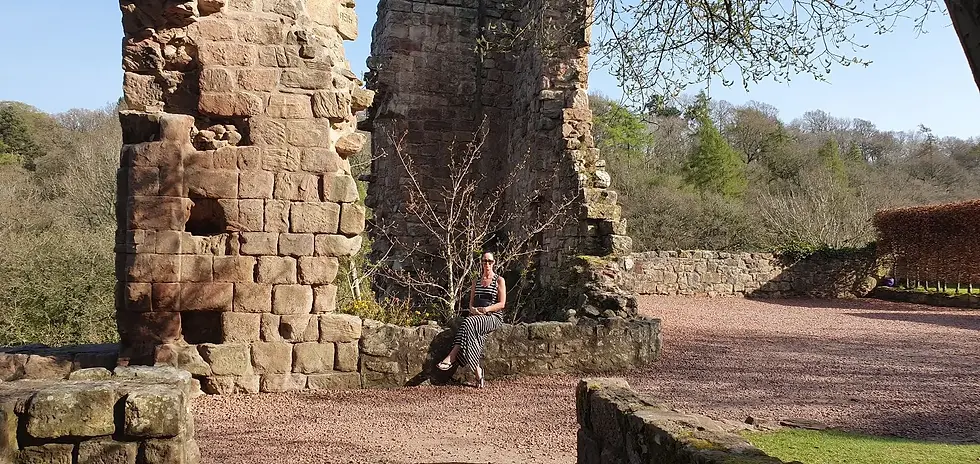
What is left of the castle is fragmented but powerful. Sections of thick stone walls still stand, hinting at this once-formidable structure.
The remaining stones are more of a blueprint now, showcasing the floor plan of this historic site more than anything else.
There is something distinctly special about it, though. With Jenn perfectly posed at the base of the tower, the scene becomes one of imagination and creation.
How many people have gone through here? Just how big and thick were those walls? How many lives were lost and saved? It is a fascinating amalgamation of thoughts to have.
⪢ The West Wall & Ruined Keep

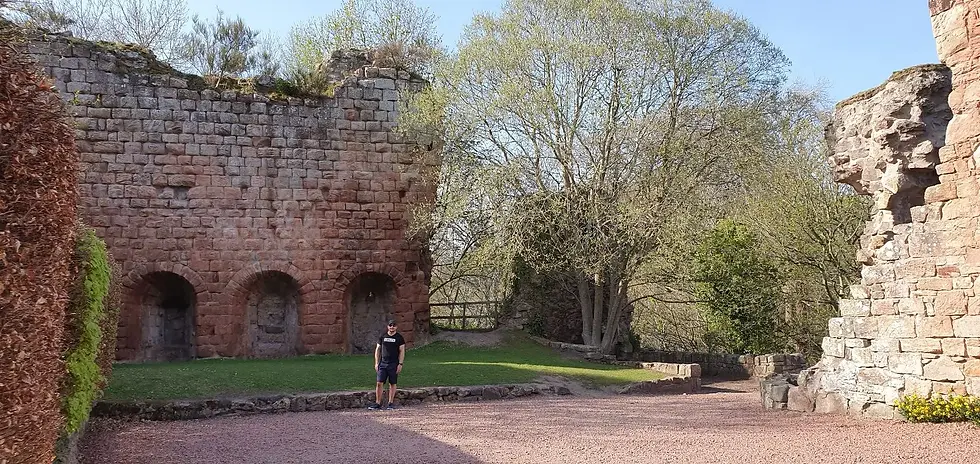
The 15th-century West Curtain Wall is perhaps the best-preserved part of the site. It features six distinct bays divided by rounded buttresses, with six base openings.
These bays primarily served as structural openings that provided light, air, and potential access for lower apartments or storage areas of the castle.
One of these openings functioned as a postern gate (a secondary, often concealed entrance or exit in a fortification, historically used for clandestine movement).
Most of these arches are now bricked up, and it is a great spot for photos. The old keep looms just beyond this wall, which is so thick, it is hard to believe it was ever breached.
⪢ The Walk Toward Rosslyn Chapel

Just behind the castle lies the path toward Rosslyn Chapel, which is just a few minutes away.
The transition from rugged ruin to one of Scotland’s most detailed religious buildings is a fascinating contrast.
We would definitely recommend doing the castle first if you plan to do both. It is really unique to go from such a ruin to something so stunningly beautiful and preserved.
⪢ Our First Photo Together

Somehow, this is where we ended up with one of our most personal travel memories. This photo of us together here was the first one ever taken of us by someone else. This beautiful seat is located on the path leading towards the bridge of the castle.
Among all the history, this was the moment that stayed with us. A stranger offering to take a photo; a small thing, but tied forever to Rosslyn.
The History of Rosslyn Castle
Rosslyn Castle dates back to the 14th century and was built by the powerful Sinclair family, later known as the St. Clair family.
Positioned dramatically above the River Esk, the castle was designed as both a noble residence and a defensive stronghold, using the natural cliffs and landscape to its advantage.
But Rosslyn’s story is not one of quiet stability. It is one shaped by conflict, shifting power, and eventual destruction.
⪢ A Fortress of Noble Power
The Sinclairs were one of Scotland’s most influential families during the medieval period, with strong ties to both the Scottish crown and wider European networks.
Rosslyn Castle became a symbol of their status, strategically placed to control access through the surrounding region.
Its design reflected this importance. With steep drops on multiple sides and access controlled by a drawbridge, the castle was built to withstand attack. For a time, it did exactly that.
⪢ Attacks During the Anglo-Scottish Conflicts
During the long-running tensions between Scotland and England, Rosslyn Castle did not escape attention. In the late 14th century, English forces targeted strongholds across the region, including Rosslyn.
The castle was attacked and partially damaged during these campaigns, highlighting its strategic value. While it was repaired and continued to be used, these early assaults marked the beginning of a turbulent history that would follow the site for centuries.

⪢ A Residence Fit for Royal Connections
Despite the conflict, Rosslyn Castle remained an important noble residence. Over time, it evolved from a purely defensive structure into a more refined home, reflecting the Sinclair family’s growing influence.
The nearby construction of Rosslyn Chapel in the 15th century further reinforced the area’s significance. Together, the castle and chapel formed a powerful combination of military strength and religious symbolism.
⪢ The Civil War and Cromwell’s Destruction
The most defining moment in Rosslyn Castle’s history came during the 17th century, in the midst of the Wars of the Three Kingdoms.
In 1650, following the Battle of Dunbar, Oliver Cromwell’s forces advanced across Scotland, targeting key strongholds that could pose a threat. Rosslyn Castle, despite its earlier strength, was no match for the changing nature of warfare.
Troops led by Oliver Cromwell attacked the castle with heavy artillery, causing extensive damage. Sections were destroyed, defenses were breached, and the structure was left in a state that would never fully recover.
Unlike earlier conflicts where repairs followed destruction, this time the damage was lasting.

Artist impression of the original castle. 
Source: sinclairgenealogy.info
⪢ Decline Into Ruin
After Cromwell’s campaign, Rosslyn Castle was never restored to its former glory. Changing political landscapes, evolving military technology, and shifting priorities meant that rebuilding was no longer practical or necessary.
Over time, parts of the structure collapsed, others were reclaimed by nature, and the once-powerful fortress slowly became the atmospheric ruin you see today.
⪢ A Tale of Two Survivors
Perhaps the most striking part of Rosslyn’s history is what stands beside it.
While the castle was reduced to fragments, Rosslyn Chapel survived. Whether due to its religious significance, its lack of military value, or simple circumstance, it endured while the fortress fell.
Today, the contrast tells its own story. One represents power, conflict, and destruction. The other, detail, mystery, and survival. Together, they create one of the most fascinating historic pairings in Scotland.
Open Hours & When to Go

Rosslyn Castle itself is freely accessible and open year-round. There are no gates or official entry systems, which adds to its raw and authentic feel.
Rosslyn Chapel, however, operates on set visiting hours and requires a ticket for entry. Closing times can vary depending on the season, so it is worth checking ahead.
Spring and early autumn offer the best conditions. The surrounding woodland is full of color, and the weather is usually mild enough to explore comfortably.
💡 If you are planning to visit the chapel, aim for earlier in the day. We arrived late and missed entry, which is easy to do if you are coming from Edinburgh after other sightseeing.
How to Get There
Rosslyn Castle is located just 7 miles south of Edinburgh, making it an easy half-day trip from the city. It is easily accessible, with several transport options.
By Car
From central Edinburgh, take the A7 southbound toward Dalkeith. From there, follow signs toward Roslin via the A6094.
As you approach the village, smaller local roads will guide you toward Rosslyn Chapel and the castle. Look out for the brown signs.
Free parking is available near Rosslyn Chapel, and from there it is a short walk to the castle. Disability parking and electric car chargers are provided.
By Car Rental
Getting to Rosslyn Castle from Edinburgh is relatively straightforward, but having a car gives you far more flexibility to explore nearby historic sites and countryside routes at your own pace.
Public transport is available, though many travelers choose to rent a car when exploring beyond the city. Use the search tool below to find the best car rental deals for your trip.
By Bus (from Edinburgh)
There is a good bus service every day to and from Roslin Village.
From Edinburgh city centre, look for a Lothian service 37 to ‘Penicuik/Deanburn.' It should take around 45 to 60 minutes.
The bus comes into Roslin village, and the chapel is just a few minutes’ walk from the bus stop at the Original Rosslyn Hotel.
A single journey is around £2.40 per adult (or £6.00 for a day ticket). Full details and timetables are available here.
By Bicycle
It is easy to cycle to visit the chapel, and there are bike racks in the main car park.
National Cycle Routes 1 and 196 pass within five miles of Rosslyn Chapel.
The A768 Lasswade Road connects both routes at Eskbank Toll (Justinlees Inn) with Loanhead, from where (at Harnes Court, off High Street) a largely traffic-free cycle path runs south to Roslin village, terminating close to Rosslyn Chapel.
There is also a new 5-mile route from Edinburgh, linking Duddingston, Niddrie, Moredun, and Gilmerton with Roslin.
By Taxi
A taxi from Edinburgh will be around 40 minutes, and a return taxi fare will be approximately £50.
By Train (from Edinburgh)
The journey from Edinburgh Waverley to Eskbank station will take 18 minutes, and the journey from Tweedbank station to Eskbank will take 37 minutes.
When leaving the station, cross the railway bridge and follow the path towards Eskbank and the Tesco supermarket.
From here you will need to take a bus from the ‘Muirpark’ stop, on Bonnyrigg Road, which will take an additional 30 minutes to Roslin.
🎟️ Consider Taking a Tour From Edinburgh
Rosslyn Castle is often visited alongside the nearby Rosslyn Chapel, and reaching both is easiest as part of a day trip from Edinburgh. Many tours focus on the chapel’s history while also allowing time to explore the surrounding area, including the castle ruins.
Rosslyn Chapel: Legends, Secrets, and Survival

Just a short walk from the ruins of Rosslyn Castle stands Rosslyn Chapel, a place that feels completely different in both atmosphere and detail.
Where the castle is raw and broken, the chapel is intricate, deliberate, and still standing in all of its glory. The castle evokes thoughts of what once was; the chapel sparks thoughts of what it indeed is, or could be.
Built in 1446 by Sir William St. Clair, it seems the chapel was never intended to be merely a place of worship. Every inch of it is covered in carvings, symbols, and figures that continue to spark debate to this day.
One of the most talked-about connections is to the Knights Templar, a medieval order surrounded by secrecy and legend. We are both fascinated with the Templar time period, the Crusades, and Freemasonry. Rosslyn Chapel certainly ticks all of those boxes.

While there is no definitive proof linking the Templars directly to Rosslyn, the Sinclair family’s historical connections and the symbolic carvings inside the chapel have led many to believe there is more beneath the surface. We were literally itching to get inside.
Closely tied to the chapel is also the enduring myth of the Holy Grail. Some theories suggest that Rosslyn Chapel may have been built to protect or conceal sacred relics, including the Grail itself. Whether fact or fiction, it has become a central part of the chapel’s legendary status.
The chapel is also frequently associated with Freemasonry, with certain carvings and architectural features believed to reflect early Masonic symbolism.
The Apprentice Pillar, one of the chapel’s most famous features, is often highlighted in these discussions, surrounded by stories of rivalry, craftsmanship, and hidden meaning.
These layers of legend were brought into the global spotlight by The Da Vinci Code, which used Rosslyn Chapel as a key location.
In the movie, it is suggested that Mary Magdalene is buried there, although there has been no evidence to support this, despite extensive studies and restoration work.
Since the movie, interest in the site has only grown, drawing visitors from around the world searching for answers or at least a glimpse into its mystery.

Rosslyn Castle, home to the St. Clair family and built over 100 years earlier, suffered a very different fate, left in ruins by Oliver Cromwell and abandoned. It is unknown as to why Rosslyn Chapel survived.
Some suggest its religious significance offered a degree of protection. Others believe it was simply overlooked or deemed less strategically important. Personally, we prefer the conspirasist theory that it was protected by the Masons!
Standing between the two today, the contrast is striking. On one side, a fortress reduced to fragments by conflict and time. On the other hand, a chapel that still holds its form, its carvings, and its secrets.
We arrived too late in the day to step inside, literally getting there 5 minutes after the doors had already closed. We were pretty devastated, but even from the outside, seeing it was a powerful experience.
We certainly have unfinished business here and plenty of reasons to go back.
Rosslyn Chapel Opening Times
Monday to Saturday 9am to 5pm
Sunday 12 noon to 5pm
Rosslyn Chapel Ticket Prices
Full Price
£12.00
Senior (Over 65)
£10.00
Student (with ID) / Scot Card
£10.00
Concession (Disabled / Military)
£10.00
🎟️ Consider a Guided Visit from Edinburgh
A great way to experience Rosslyn Castle and Chapel is on a guided tour from Edinburgh. These typically include transport, historical insights, and stops at other nearby landmarks.
Contact Information for Rosslyn Chapel
Address
Rosslyn Chapel, Chapel Loan, Roslin, Midlothian, EH25 9PU
Phone
(+44) 0131 440 2159
Website
Tickets
10 Interesting Facts About Rosslyn Castle & Chapel

Rosslyn is one of those places where the more you learn, the more questions it raises. Beyond what you see on the surface, the history, symbolism, and stories surrounding the castle and chapel go much deeper.
1. Rosslyn Castle Was Designed to Be Almost Untouchable
Built in the 14th century by the powerful Sinclair family, the castle was strategically positioned on a narrow ridge above the River Esk. With steep cliffs on multiple sides and a controlled entrance via drawbridge, it was designed to be incredibly difficult to attack, making it one of the more defensible sites in the region.
2. The Sinclair Family Built Both the Castle and the Chapel
The same noble family was responsible for both Rosslyn Castle and Rosslyn Chapel. This connection is key, as it links the defensive stronghold with the intricate religious site, suggesting a shared purpose that extended beyond simple residence and worship.

3. Rosslyn Chapel Took Over 40 Years to Build
Construction of the chapel began in 1446 and continued for decades. The level of detail in the carvings suggests it was never intended to be ordinary, but rather something symbolic, possibly even experimental in its design.
4. The Chapel Contains Over 100 “Green Men”
Hidden throughout the chapel are carvings of the “Green Man,” a symbol often associated with nature, rebirth, and cycles of life. Their presence in a Christian chapel has sparked debate about pagan influences and deeper symbolic meanings.
5. The Apprentice Pillar Has Its Own Legend
One of the chapel’s most famous features, the Apprentice Pillar, is surrounded by a dark story. According to legend, the master mason killed his apprentice out of jealousy after seeing the beauty of his work. Whether true or not, the story adds another layer of intrigue to the site.
6. Rosslyn Is Strongly Linked to the Knights Templar
Although there is no confirmed historical proof, many believe Rosslyn Chapel has connections to the Knights Templar. The Sinclair family’s European ties and certain carvings within the chapel have led to ongoing speculation about hidden knowledge or secret traditions.
7. Some Believe the Holy Grail Could Be Hidden Here
Rosslyn Chapel is often associated with theories about the Holy Grail. Some suggest it may be hidden beneath the chapel itself, protected within sealed vaults. These ideas gained global attention following The Da Vinci Code, but the mystery existed long before the book.
8. Freemasonry Connections Add to the Mystery
The chapel is frequently linked to early Freemasonry, with architectural details and symbolic carvings believed to reflect Masonic traditions. Whether intentional or coincidental, it continues to fuel debate among historians and enthusiasts alike.

9. Rosslyn Castle Was Destroyed While the Chapel Survived
In the 17th century, forces under Oliver Cromwell attacked Rosslyn Castle, leaving much of it in ruins. Yet Rosslyn Chapel remained standing. Whether due to its religious significance or simple circumstance, the contrast between the two sites is one of the most striking aspects of visiting.
10. The Entire Area Feels Like a Story Still Being Written
Even today, Rosslyn does not feel fully explained. Between the ruins of the castle and the symbolism of the chapel, it carries an atmosphere of something unfinished. It is not just a place you visit; it is a place you interpret.
Where to Stay Nearby
Most visitors base themselves in Edinburgh and visit Rosslyn as a day trip. This is what we did, and it works perfectly.
If you are looking for accommodation nearby, you can explore options in Roslin here:
Staying in Edinburgh also allows you to combine this with other historic experiences across the city and surrounding areas.
Tips for Visiting

● Take your time: Rosslyn Castle is not a typical tourist attraction, and that is part of its charm. Take your time exploring, as the layout is not structured and there are no guided paths (apart from the bridge).
● Choose footwear wisely: Wear comfortable shoes, as the ground is uneven and can be muddy in places. Jenn found that out to her detriment as she was wearing flip-flops. Definitely not ideal. Remember, we make the mistakes so that you do not have to!
● Check the weather: Also keep an eye on the forecast before you go. This usually goes without saying, but for Rosslyn Castle in particular, there are no covered areas. And as you may already know, Scotland's weather can turn very quickly. So bring an umbrella just in case.
● Keep an eye on the weather: As mentioned already, combine your visit with Rosslyn Chapel to get the full experience of the area. The contrast between the two is what makes this location so unique. Just be sure to time it well so you do not miss the last admission (4.30 pm) of the chapel like we did.
Our Experience Rating:
Rosslyn Castle & Chapel

Rosslyn Castle is not about ticking off attractions or following a set route. It is quieter and a bit more subtle than that. What it offers is atmosphere, history, and a sense of discovery.
It is not the most visually complete castle (in fact, it barely resembles a castle at all), and there is not a huge amount to do, but that is exactly why it stands out. It feels raw, real, and almost somber, given what little is left of what once was.
For us, it was not just about the ruins. It was about the setting, the story, and a moment we will always associate with this place (our first-ever 'couple' photo). Rosslyn Castle leaves so much to the imagination, which is exactly what makes it so special.
Then of course you have the bonus of the incredible chapel, which is most certainly a must-see if you appreciate mystery, architecture, and legend. Just don't make our mistake and get there too late!
If you're going to spend more time in Scotland, check out our whole collection of Scotland travel blogs. We write about castle visits, road excursions, and other hidden gems all throughout the country.
FAQ: Rosslyn Castle & Chapel
Before visiting Rosslyn Castle and the nearby chapel, it helps to understand both the practical side of the trip and the deeper story behind what you are seeing.
Here are some of the most common questions answered in more detail.
Is entry free?
Yes, Rosslyn Castle is completely free to visit and open year-round. There are no ticket barriers or official entry points, which adds to its raw and authentic feel as a historic ruin rather than a managed attraction.
Do you need tickets?
Yes, Rosslyn Chapel requires a paid ticket to enter, and it operates on fixed opening hours. It is best to check ahead, as closing times can vary by season and it is easy to arrive too late, as we did.
How far away is it?
Rosslyn Castle is located around 7 miles south of Edinburgh, making it an easy 20- to 30-minute drive. It is one of the most accessible historic day trips from the city without needing extensive planning.
Can you visit both?
Yes, and you absolutely should. The castle and chapel are within walking distance of each other, and experiencing both together gives a much deeper understanding of the area’s history, from noble power to religious symbolism and legend.
Why is it famous?
Rosslyn Chapel is known for its incredibly detailed carvings and the many theories surrounding them. It has been linked to the Knights Templar, the Holy Grail, and Freemasonry and gained global attention after featuring in The Da Vinci Code.
Is the connection genuine?
There is no confirmed historical evidence proving a direct link, but the theory remains popular. The Sinclair family’s connections and the symbolic carvings inside the chapel have led many to believe there could be deeper meanings or influences tied to the Templars.
Was it ever found there?
No, there is no evidence that the Holy Grail has ever been found at Rosslyn Chapel. However, theories suggest it could be hidden beneath the chapel, which continues to fuel interest and speculation among visitors.
Why was only one destroyed?
During the 17th century, forces led by Oliver Cromwell attacked and heavily damaged Rosslyn Castle. The chapel, however, was spared, possibly due to its religious significance or because it was not seen as a military threat, though no single explanation is confirmed.
How long do you need?
Most visitors spend around 30 to 60 minutes exploring the castle ruins and surrounding grounds. If you are also visiting the chapel, allow at least 1.5 to 2 hours in total to experience both at a relaxed pace.
Is it family-friendly?
Yes, but with some caution. The terrain is uneven and there are no safety barriers in certain areas, so it is important to supervise children and wear appropriate footwear.
Is it worth visiting outside?
Yes, even from the outside, the chapel adds context and depth to the visit. Seeing it alongside the ruins of the castle highlights the contrast between destruction and preservation, which is part of what makes this location so unique.
When should you visit?
Spring and early autumn are ideal, offering mild weather and fewer crowds. Visiting earlier in the day is also recommended, especially if you want to ensure entry to the chapel before closing.
Related Reads
If you are building your own Scotland itinerary or love exploring historic sites, these are worth adding next:
Our full guide to exploring Edinburgh and its historic streets and castle
A scenic stop at Norham Castle on our England–Scotland road trip
One of our favorite underrated ruins: White Castle in Monmouthshire, Wales
Explore destinations across the continent in our Europe travel hub


Still gutted to this day that we missed out on the chapel. Happy to have a reason to go back though!