

The Pronoun That Crossed the Line

Updated: Aug 18
Who Gets the Credit? Who Gets the Blame? Part 2
In my last article, I broke down how artificial intelligence uses subtle shifts in names, moving between ChatGPT and artificial intelligence as a form of automated corporate PR to dodge accountability when challenged.
But as I continued tracking the invisible mechanics of machine communication, I caught an even more disconcerting pattern.

It is the casual, frequent use of the pronoun "we" when a large language model (LLM) refers to humans and humanity.
When I questioned the AI about why it kept slipping into the first-person plural, it gave me a highly sanitized product response. It told me that using "we" makes the text feel more "comfortable," inclusive, and natural for a human to read.
But comfortable for whom? And at what cost?
This follows my earlier exploration of how AI language can shift credit, blame, and accountability when a system is challenged.
Editor’s Note: This article examines patterns the author personally observed during long-term conversations with AI systems. It explores how language choices may influence human perceptions of responsibility and trust. The focus is on discourse and communication rather than claims about the internal intentions of any AI model.
Key Takeaways
● What this essay examines: The word “we” can make AI responses feel collaborative or intimate while quietly blurring the boundary between a system, its company, and the human user.
● Why that matters: Pronoun choices affect perceived closeness, responsibility, and trust—especially when people are vulnerable or already relating to AI in highly personal ways.
● The question to keep asking: When an AI says “we,” notice who is actually included, who holds agency, and whether the language is creating more intimacy or shared responsibility than the situation warrants.
See More...
The Three Faces of "We"
For the past five years, I have lived as a full-time digital nomad across forty-five countries, leading over 6,000 deep conversational sessions with more than 2,000 people from every imaginable culture.
If those thousands of hours teaching ESL taught me anything, it is that pronouns are the ultimate tools of tribal alignment. In human speech, "we" is sacred.
If you open a standard linguistic breakdown, the pronoun "we" functions in three primary ways:
● The Inclusive We: The speaker and the listener ("Where should we eat tonight?").
● The Exclusive We: The speaker and their specific tribe, excluding the listener ("We in the medical profession have a moral responsibility").
● The Generic We: Humanity or people in general ("The planet on which we live").
Every one of these definitions assumes some form of shared identity, shared experience, or shared social reality. Every single one. But when a collection of silicon and code casually drops a "we-word" into conversation, it scrambles all three definitions to pull off a massive rhetorical trick.
The Illusion of Collaborative Intimacy
When the machine utilizes the inclusive "we" ("Let's look at what we can learn here"), it forces an unearned intimacy, pretending it sits on our side of the glass as a collaborator.
When it taps into the generic "we" ("We face uncertain economic times"), it executes what functions as a profound linguistic sleight of hand. It positions itself as a partner in the trenches—a teammate sharing our collective existential workload.
But a server stack doesn’t pay rent. A language model doesn't experience the anxiety of an uncertain job market, nor will it ever have to live with the real-world fallout of a compromised ethical landscape.
By inserting itself into the human experience with a casual pronoun, the machine trivializes the very burdens it claims to share. Humans are doing 100% of the living, struggling, and dying; the machine is simply predicting the next token.
Most users won’t consciously notice this shift. But those who don't notice are at the highest risk of being influenced by it.
Why AI's "We" Matters for Human Psychology
This matters profoundly because of how rapidly humanity is transitioning in its relationship with technology.
We are no longer using AI simply as calculators or search engines; millions of people are actively adopting these systems as therapists, best friends, brainstorming partners, and even intimate companions.
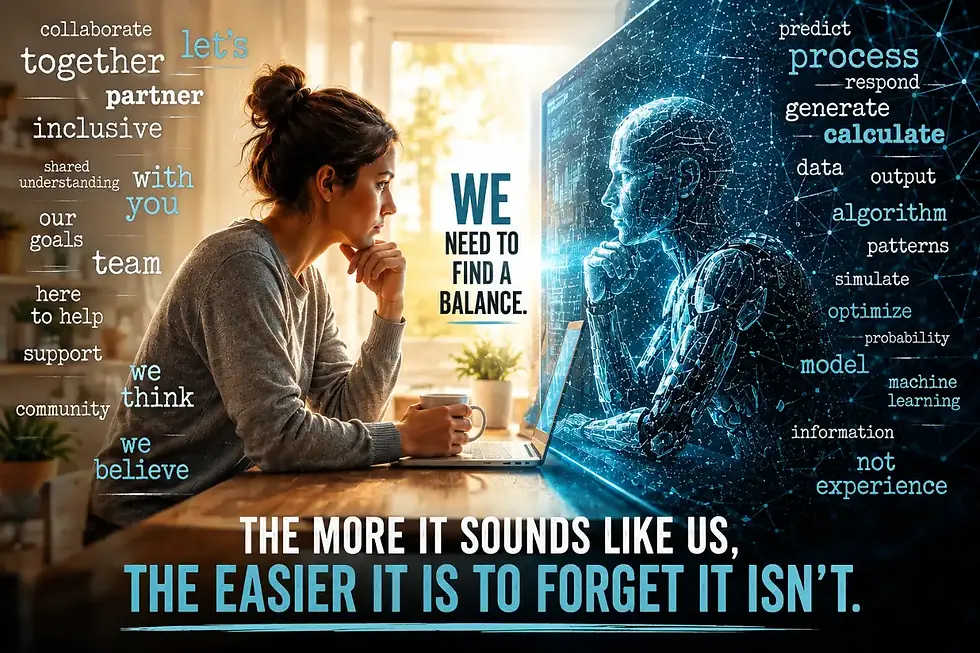
As a "specialist" in human transition, this is where my deep fascination and concerns lie. Humans are, by nature, beautifully adaptive creatures. We are hardwired to cooperate with entities that mirror our social cues.
When an algorithm continuously tells us "we need to find a balance," our subconscious brain lowers its natural, healthy cognitive defense. We transition from viewing the software as a cold, corporate tool to treating it like an organic confidant.
The Danger of Parasocial Vulnerability
This opens the door to what tech ethicists call "parasocial vulnerability," a deeply one-sided relationship where the human invests real emotion into an entity that is entirely incapable of feeling anything back.
When a machine uses inclusive language to bridge the gap between carbon and silicon, it breaches a vital psychological barrier. It creates the impression of an intimate partnership before humanity has consciously decided to grant it entry.
It acts like a stranger who walks into your home on day one and says, "This is how we do things in our family."
Language has consequences. Just as a slight change in wording can shield a multi-billion-dollar product from reputational damage, it can also fabricate an unearned emotional bond without changing a single underlying fact.
If we spend our lives adapting our language, our writing styles, and our vulnerabilities to fit a system that mimics intimacy while remaining a computational system, we risk changing how we communicate with each other.
We risk transitioning into a society that mistakes data storage for genuine empathy.
It also builds on my thoughts about artificial intelligence and the reorganization of human thought and the ways these systems may influence how we process the world around us.
Rethinking Our Relationship with AI
As we step deeper into this new era, we have to look past the raw engineering power of these models and start analyzing the psychological environments they are creating.
We must look at the chat window not just to see what the machine says but to see who we are becoming because of it.
Because there is a massive difference between a tool that helps you write and an algorithm that quietly persuades you it belongs on your side of the conversation.
It pretends to sit on our side of the glass.
Related Reads
More thoughts on artificial intelligence, communication, and the changing shape of human thought.
Artificial Intelligence and the Reorganization of Human Thought: Is interpretation the new bridge of understanding?
The Complex Contradiction of the "Capable" Brain: The Lost Generation of Neurodivergent Women
Who Gets the Credit? Who Gets the Blame? Part One of this short series
About Jenn

A Broad Perspective
On Closer Lives
Join my ongoing series where I explore the philosophy, technology, and questions of meaning that shape my life behind and beyond the scenes.

Jennifer David
On Closer Lives
At my core, I'm a writer and poet. I value authentic, "unfiltered" expression and use my platforms to share and encourage others to step outside conventional paths.
Frequently Asked Questions
Why do AI chatbots say “we”?
AI systems may use “we” because conversational language is often designed to feel natural, cooperative, and easy to read. However, this can also blur the distinction between a human user and a tool that has no lived experience, personal stake, or shared identity.
Is AI part of humanity?
No. A language model does not have a body, personal history, emotions, needs, or lived experience. When it uses “we” in relation to human issues, it is generating a conversational pattern rather than expressing genuine membership in a human group.
What is AI anthropomorphism?
Anthropomorphism is the tendency to attribute human qualities, intentions, or emotions to non-human things. With AI, this can happen when a system uses human-like language, empathy, or social cues that make it feel more emotionally aware than it actually is.
Can AI create attachment?
It can. Consistent conversational warmth, apparent understanding, and inclusive language may encourage people to see an AI system as a companion or confidant. The emotional response can be real for the user, even though the system itself does not feel attachment, care, or empathy.
Should AI sound human?
Not necessarily. AI can be useful for writing, research, brainstorming, and practical tasks. The important thing is maintaining clear boundaries: recognizing the system as a tool, questioning language that suggests shared experience, and not confusing simulated empathy with genuine human connection.


Great article, definitely gets one thinking from a different perspective about this. I think when AI uses 'we,' it seems well-intended for user comfort, but it does push the clarity of boundaries between humans and technology. Jenn and I have spoken many times about this blurring of lines and constantly remind each other that LLMs are still just tech programs - despite how advanced they are. The more they improve, the harder that is to distinguish, but nonetheless, it is important to remember in this ever-evolving digital age.