

Is the Discover Doha Transit Tour Worth It? Our Qatar Layover

Updated: Aug 25
An 18-hour airport layover does not usually sound like the most exciting part of an international journey.
However, when our route from Thailand to England gave us almost an entire day at Hamad International Airport, we decided it was too good an opportunity to waste.
Rather than spending every hour inside the terminal, we booked the Discover Doha transit tour and turned an unavoidable connection into our first experience of Qatar.

Our visit came during a period of heightened regional tension and disrupted flight options between Asia and Europe.
The realistic routes available to us involved connecting through either Doha or Bahrain, and after looking at the flights still operating, we felt more comfortable traveling through Doha.
We had booked approximately a month in advance and hoped our journey would proceed without disruption.
Thankfully, our Qatar Airways flights operated normally, our transit was remarkably smooth, and we were able to explore Doha without any problems.
Travel conditions can change quickly, so always check current airline updates, government travel advice, and insurance coverage before traveling.

Key Takeaways
● Excellent value for a quick overview: At QAR 115 per person, the three-hour tour covered the Corniche, Katara Cultural Village, and Souq Waqif with a knowledgeable guide.
● Designed for transit passengers: Air-conditioned transport, luggage storage, clear meeting instructions, and a timed airport return removed most of the stress from our 18-hour layover.
● Short stops are the trade-off: Independent metro travel gives you more time at each place, but the organized evening tour was the better option for us in Doha's intense summer heat.
Flying from Bangkok to Doha with Qatar Airways
Our journey began with a short flight from Chiang Mai to Bangkok, followed by a night at the Hyatt Regency before our early-morning departure.
Our Qatar Airways flight left Bangkok at approximately 5am and took around six hours to reach Doha.
Qatar Airways has built a formidable reputation for its onboard service, and our experience largely lived up to it. Even in economy, we had reasonable legroom, attentive service, and an extensive selection of films and television through the Oryx One entertainment system.
Despite the early departure, breakfast was included and gave us a chance to settle into the flight before attempting to rest.
Our aircraft also offered onboard internet. The package presented to us included one complimentary hour, followed by a charge of approximately $10 USD for continued access during the flight.
Qatar Airways is progressively installing complimentary Starlink internet across its fleet, but availability and the system offered can depend on the aircraft operating your route.
Overall, it was a comfortable and well-managed flight, particularly for economy.
Arriving at Hamad International Airport
We have been here before, but we didn't leave the airport!
Because both flights were on the same booking, our checked suitcases were transferred automatically to our onward flight to England.
That made the layover considerably easier. We only had to carry our hand luggage and did not need to collect or recheck any bags.
We knew that leaving the airport would require us to pass through Qatari immigration, but the process turned out to be far simpler than we expected. Hamad International Airport is enormous, yet it is clearly signposted, professionally managed, and surprisingly easy to navigate.
The automated passport gates made immigration particularly efficient for compatible passports. We scanned our passports, passed through the gates, and were formally admitted into Qatar within minutes.
Entry eligibility varies by nationality, so passengers should confirm Qatar's current visa and visa-free entry requirements before booking a transit tour.
Should You Explore Doha Independently During a Layover?

We initially considered exploring Doha by ourselves. Doha has an excellent public transport system, and Hamad International Airport is directly connected to the city by metro.
This makes independent exploration a realistic and relatively affordable option, especially if you are comfortable navigating public transport and already know which attractions you want to visit.
Our tour host also described Doha as one of the safest cities in the world. That was reassuring to hear, although travelers should always check current government travel advice and remain aware of their surroundings wherever they go.
With an 18-hour layover, exploring independently could have allowed us to see considerably more. The organized tour only lasts three hours, and the short stops provide an introduction rather than enough time to explore places such as Katara Cultural Village or Souq Waqif properly.
However, we were visiting during the height of summer, when temperatures can reach or exceed 45°C during the day. We also did not want the hassle of planning our route, carrying our hand luggage around the city, or constantly checking how long it would take to return to the airport.
For us, the organized tour removed most of that uncertainty. Transport, timings, and the return journey were all handled for us, while the air-conditioned coach provided essential relief from the heat.
We also gained far more historical and cultural context from our guide than we would have discovered simply moving between attractions alone.
If you have a long layover, cooler weather, and the confidence to use the metro, exploring independently may be the better option. If you want a straightforward introduction to Doha without having to plan anything, the Discover Doha tour is extremely convenient.
How We Booked the Discover Doha Transit Tour
Discover Qatar operates a selection of tours specifically for passengers connecting through Hamad International Airport.
We found the tour desk easily after arriving. There is also a Discover Qatar Transit Tour desk in the baggage claim area and the Duty Free Plaza South (behind the escalators), which serves as the official meeting point.
The standard Discover Doha city tour cost us QAR 115 per adult, approximately $32 USD per person. It lasted three hours and required a minimum recommended transit time of six hours.
A range of departure times was available throughout the day and into the night. Private tours were also offered for passengers wanting a more flexible itinerary, private vehicle, or longer experience.
We selected the 7pm departure because our onward flight was scheduled shortly after 1am. The tour was due to finish at approximately 10pm, giving us enough time to re-enter the airport, clear security, and reach our departure gate.
Current times, prices, and availability should be checked directly through the official Discover Qatar transit tours page.
Why We Chose an Evening Tour

The airport staff recommended choosing an evening departure because of the summer heat. That was excellent advice.
Even at 7pm, the temperature still felt close to 40°C. Walking outside felt like stepping directly into a sauna. The heat was immediate, heavy, and powerful enough to make us sweat within minutes.
Most outdoor areas were noticeably quiet until after sunset, with locals and visitors understandably avoiding the most intense part of the day.
The 7pm and 8pm tours appeared to be among the most popular departures, and our coach had roughly 30 passengers. If you want an evening tour, we recommend booking several hours ahead because these departures can sell out.
Waiting at Giraffe World Kitchen

With plenty of time to burn before the tour, we explored Hamad International Airport and eventually settled at Giraffe World Kitchen.
The restaurant was colorful, comfortable, and a convenient place to wait with our hand luggage. We ordered nachos and a pasta dish, both of which were well presented and enjoyable.
As expected for a major international airport, the meal was relatively expensive, but the trade-off was worth it for somewhere quiet to sit for several hours before meeting the tour group.
Loaded nachos Pasta mozzarella
Meeting the Tour Group

We returned to the Discover Qatar desk at approximately 6pm, one hour before departure.
After a short briefing, a member of staff guided the group through the airport and towards immigration. Each passenger received an identification card, and all instructions were delivered clearly in English.
There was a fair amount of walking involved. Hamad International Airport is vast, so passengers with limited mobility should discuss assistance with the tour operator in advance.

Once outside, we waited briefly near the information desk for our guide and coach.
Passengers are permitted to leave the tour and make their own way back to the airport if necessary, although doing so means accepting responsibility for returning in time for their flight.
We had no intention of abandoning the tour. With the heat, unfamiliarity of the city, and approaching departure time, staying with the group was easily the most comfortable option.
The Discover Doha Coach
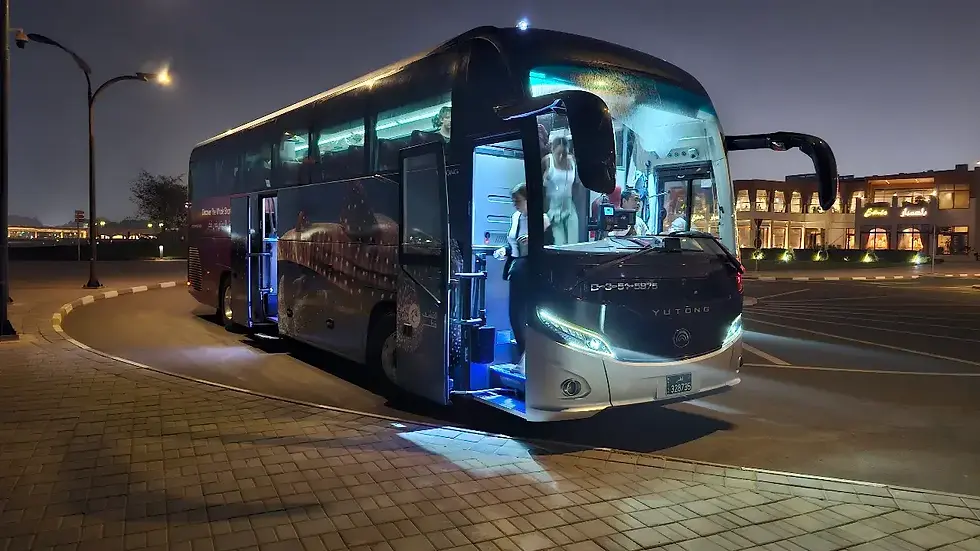
The coach was clean, comfortable, and fully air-conditioned. That air conditioning was not merely a pleasant extra. It was essential. Condensation streamed down the windows as the cooled interior battled the intense humidity outside.
Our larger hand luggage could be stored in the compartment underneath the coach, so we did not have to carry it during each stop. The driver remained with the vehicle throughout our tour, which gave us additional peace of mind when leaving our belongings behind.
We would still recommend keeping passports, boarding passes, money, electronics, and other valuables with you.
This convenience was particularly useful at Katara Cultural Village and Souq Waqif, where carrying bags through the heat would have made the short walking stops considerably less comfortable.
Bottled water was provided, although it was not chilled. We still appreciated having it, particularly after each outdoor stop.

Our guide was friendly, informative, and enthusiastic about Doha. During the drives between attractions, he discussed the city's rapid development, employment opportunities, transport system, public services, architecture, climate, and daily life in Qatar.
Although part of the tour is necessarily spent driving, the commentary made those sections feel worthwhile.
A Brief History of Doha

Doha's transformation has been extraordinary. Before the discovery and development of oil and natural gas, Qatar's economy relied heavily on fishing, pearl diving, and maritime trade.
The decline of the natural pearl industry in the early 20th century caused considerable hardship across the Gulf. Oil exports later brought rapid economic change, followed by the development of Qatar's enormous natural gas reserves.
Doha expanded from a relatively small coastal settlement into a global capital filled with modern towers, cultural institutions, universities, sports facilities, and large-scale infrastructure.
That recent growth was evident throughout our tour. Much of the city felt exceptionally new, clean, and carefully planned, yet places such as Souq Waqif and the traditional dhows continued to reflect Qatar's older trading and maritime identity.

Our Discover Doha Tour Highlights
First Stop: Doha Corniche and the Traditional Dhows

Our first stop was along Doha's waterfront, approximately 20 to 30 minutes from Hamad International Airport.
The Corniche is a sweeping waterfront promenade overlooking the Arabian Gulf and the illuminated towers of West Bay. From this side of the bay, the modern Doha skyline formed a striking backdrop across the water.
It was also where we saw Qatar's traditional wooden boats, known as dhows. Dhows were historically used throughout the region for fishing, pearl diving, trade, and transporting goods. Today, many of the boats along the Corniche operate sightseeing and dinner cruises, connecting modern tourism with Qatar's maritime heritage.
The stop was peaceful and atmospheric, particularly with the skyline illuminated after dark. It was also surprisingly quiet, largely because of the heat.
Photography was difficult in the darkness, but the waterfront still gave us our first proper sense of Doha. After around 15 minutes, we were more than ready to return to the air-conditioned coach!
Second Stop: Katara Cultural Village

Our next stop was Katara Cultural Village, one of Doha's principal centers for arts, architecture, and cultural events.
Katara was designed as a place where Qatari heritage could sit alongside contemporary art, performance spaces, galleries, restaurants, and public events.

Rather than being one museum, it is a large cultural district containing several distinctive buildings.
This was probably the most visually impressive stop on the tour.
Katara Amphitheatre

The enormous open-air Katara Amphitheatre combines classical Greek influences with Islamic architectural details.
Its pale stone, towering arches, and symmetrical seating gave it a grand, almost cinematic quality. At night, the illuminated stairways reflected across the polished ground while the entire space remained remarkably quiet.

Our group was virtually alone inside, which made the amphitheater feel even more dramatic.
The Katara Mosque and Pigeon Towers

Near the amphitheater stands the beautifully decorated Katara Mosque, designed by Turkish architect Zeynep Fadıllıoğlu.
Beside it are Katara's famous pigeon towers. These are the distinctive structures we remembered as towers with wooden sticks projecting from them.
The sticks serve as perches, while numerous small openings provide nesting spaces for pigeons.

Traditional pigeon towers were once practical pieces of architecture. Pigeons could shelter and nest inside them, while their droppings were collected and used as fertilizer.
The Katara towers preserve this feature of regional architectural heritage.
Art Galleries and the 2022 FIFA World Cup

We also entered one of Katara's air-conditioned gallery buildings, which was extremely welcome after walking outside.
One exhibition contained photography and artwork connected to the 2022 FIFA World Cup, including images of Argentina's victory and Lionel Messi lifting the trophy.
Another gallery featured a striking installation of suspended jellyfish created from discarded plastic and other repurposed materials. It was colorful, unusual, and carried a clear environmental message about marine pollution.

Katara is home to rotating exhibitions, workshops, and cultural programs, so visitors may encounter something entirely different depending on when they arrive.
Our stop lasted roughly 25 minutes. It was not long enough to explore Katara in depth, but it introduced us to an area we would happily revisit.
Seeing Fanar from the Coach

As we continued through central Doha, we passed one of the city's most recognizable buildings: Fanar, the Qatar Islamic Cultural Centre.
Its illuminated spiral minaret immediately stands out above the surrounding buildings near Souq Waqif.
The design is inspired by the Great Mosque of Samarra in Iraq. Fanar serves as a mosque and cultural center, offering educational programs and information about Islamic culture.
This was not the tower with the projecting sticks, which was one of Katara's pigeon towers, but it was the distinctive spiral minaret visible in our photographs as we approached the market.
Final Stop: Souq Waqif

Our final stop was Souq Waqif, Doha's famous traditional market. This was our favorite part of the tour!
The main pedestrian streets were lined with cafés and restaurants, while powerful outdoor fans attempted to cool the evening crowds. After seeing so few people elsewhere, the souq felt lively, sociable, and full of character.

Behind the main restaurant area, narrow passages twisted between shops selling perfumes, clothing, spices, kitchenware, artwork, textiles, souvenirs, and household goods.
The maze of covered lanes reminded us of Istanbul's Grand Bazaar, although Souq Waqif felt smaller and more relaxed.
Many shops were air-conditioned, and their cool air spilled into the passageways whenever the doors opened. In Doha's summer heat, even those brief pockets of cold air felt wonderful.
Swipe for more >>>
The market's traditional appearance is partly reconstructed. Souq Waqif was restored using local building materials and historic Qatari architectural techniques, helping preserve the atmosphere of the original trading area, which is over 250 years old.
Our time here was limited, but it was enough to experience the market's energy and understand why it is considered one of Doha's essential attractions.
Returning to Hamad International Airport
After Souq Waqif, we returned to the coach for the journey back to Hamad International Airport.
The return process was impressively smooth. Security was organized and efficient, while automated passport gates made immigration remarkably quick.
We arrived back airside with enough time to reach our gate without rushing. Even so, we would not recommend choosing a tour that leaves only a narrow margin before your onward flight. Flight gates can be a considerable distance from immigration, and unexpected delays are always possible.
Discover Qatar requires a minimum six-hour transit for this city tour, but we would personally feel more comfortable with at least seven or eight hours.
Discover Doha Transit Tour Information
● Price during our visit: QAR 115 per adult, approximately $32 USD
● Duration: Three hours
● Required transit time: Six hours
● Meeting time: Approximately 60 to 90 minutes before departure
● Meeting point: Discover Qatar Transit Tour desk, Duty Free Plaza South
● Transport: Air-conditioned coach
● Luggage: Larger hand luggage could be stored beneath our coach
● Driver: Remained with the coach during each stop on our tour
● Water: One bottle provided
● Language: Tour commentary delivered in English
● Independent alternative: Doha Metro connects the airport with central Doha
💡 Prices, schedules, routes, and luggage arrangements can change, so confirm the latest information before traveling.
Alternative Doha Layover Tours
The official Discover Qatar tour worked perfectly for us, but it is not the only way to explore Doha during a long connection.
GetYourGuide also lists private and small-group layover tours with airport pickup and drop-off, which may suit travelers who want a longer itinerary, greater flexibility, or more time at each attraction.
Best Time to Take the Tour

For a summer layover, we strongly recommend an evening departure.
The 7pm or 8pm tours allow you to see the Doha skyline illuminated, experience Souq Waqif when it becomes livelier, and avoid the most punishing daytime sunshine.
It will still be extremely hot, particularly between June and September, but the conditions are more manageable after sunset.
Between November and March, daytime departures should be much more comfortable.
Tips for Taking a Doha Transit Tour
✓ Confirm your eligibility to enter Qatar before booking.
✓ Allow at least seven or eight hours between flights where possible.
✓ Book popular evening departures early.
✓ Wear lightweight, respectful clothing that covers shoulders and knees.
✓ Choose comfortable footwear because the tour involves considerable walking.
✓ Carry a reusable water bottle or buy cold water before departure.
✓ Keep your passport, boarding pass, money, electronics, and other valuables with you.
✓ Larger hand luggage could be stored beneath our coach, but confirm the current arrangements with the operator.
✓ The driver remained with our coach throughout the stops, although you should still avoid leaving valuables behind.
✓ Consider exploring independently if you have a very long layover and want more time at each attraction.
✓ Doha's metro connects Hamad International Airport with the city and can make independent exploration straightforward.
✓ Plan your route and airport return time before leaving the terminal.
✓ Do not rely on the tour returning significantly earlier than scheduled.
✓ Check your onward gate once you re-enter the airport.
✓ Monitor regional travel advice and airline updates before departure.
10 Interesting Facts About Doha and Qatar

1. Doha is Qatar’s capital and largest city: It is the country’s political, economic, and cultural center, combining futuristic architecture with historic markets and a traditional waterfront.
2. Qatar occupies a peninsula extending into the Arabian Gulf: Although it is relatively small, its position between Asia, Europe, and Africa has helped make it an important international transport and business hub.
3. Traditional wooden dhows were historically used for fishing, pearl diving, and trade: These boats once played an essential role in Qatar’s economy, and many now carry visitors along Doha’s waterfront on sightseeing and dinner cruises.
4. Doha’s Corniche stretches for approximately seven kilometers around Doha Bay: The crescent-shaped promenade connects several important attractions and provides some of the best views of the city’s modern skyline.
5. Qatar hosted the FIFA World Cup in 2022: It became the first country in the Middle East and the Arab world to host the tournament, bringing major investment in stadiums, public transport, and tourism infrastructure.

6. Katara Cultural Village contains galleries, theaters, mosques, workshops, and a large open-air amphitheater: The district was created to celebrate Qatari heritage while also providing a platform for contemporary art, performances, and international cultural events.
7. Katara’s pigeon towers preserve a traditional feature of regional architecture: The towers provided nesting spaces for pigeons while allowing their droppings to be collected and used as natural fertilizer.
8. Fanar’s spiral minaret was inspired by the Great Mosque of Samarra in Iraq: Its distinctive illuminated design makes the Qatar Islamic Cultural Centre one of the easiest landmarks to recognize in central Doha.
9. Souq Waqif means “the standing market”: The name is connected to the traders who once stood beside the road or waterfront to display and sell their goods.
10. Hamad International Airport is one of the world’s major international transit hubs: Its location allows it to connect passengers traveling between Asia, Europe, Africa, and the Americas, which is why so many travelers experience Doha during a layover.
Our Experience Rating:
Discover Doha Transit Tour

For QAR 115 per person, we thought the tour represented excellent value. It included comfortable air-conditioned transport, luggage storage, a friendly local guide, and enough variety to give us a genuine introduction to Doha.
Approximately half the experience is spent traveling between locations, but the guide’s commentary and views from the coach make the journey part of the experience. The main limitation is the short time at each attraction, so this is best understood as a snapshot of Doha rather than a comprehensive city tour.
With an 18-hour layover, we could probably have seen more by using Doha’s metro and creating our own itinerary. However, exploring independently in temperatures approaching 45°C would have been far less comfortable, particularly during the day.
For our first visit, during the hottest part of the year, the convenience of the organized tour worked perfectly. We recommend choosing an evening departure in summer, when Doha looks particularly impressive after dark.
If you have a layover of ten hours or more and would otherwise spend the entire time inside Hamad International Airport, we would absolutely recommend the tour.
Frequently Asked Questions
Is the Doha tour worth it?
Yes. We rated it 5/5 because the tour was affordable, professionally organized, and included several of Doha's best-known locations without requiring us to arrange transport independently.
How much does the tour cost?
We paid QAR 115 per person, approximately $32 USD. Prices can change, so check the official Discover Qatar website before traveling.
How long is the tour?
The standard city tour lasts approximately three hours. You must also arrive at the meeting point before departure and allow time for immigration and security.
How long should my layover be?
Discover Qatar specifies a minimum transit time of six hours. We would prefer at least seven or eight hours to provide a more comfortable margin.
Do I need a Qatar visa?
That depends on your nationality. Many passengers are eligible for visa-free entry, while others may require a visa. Entry remains subject to approval by Qatar's immigration authorities.
What happens to checked bags?
If your checked luggage is tagged through to your final destination, it should be transferred automatically. Confirm this when checking in for your first flight.
In our case, larger hand luggage could be stored beneath the coach, while we kept our passports, boarding passes, and valuables with us.
What attractions are included?
Routes can change, but our tour included the Doha Corniche, views of traditional dhows and the West Bay skyline, Katara Cultural Village, and Souq Waqif.
Is the summer tour suitable?
Yes, but choose an evening departure. Temperatures can show 30°C (86°F) but can easily feel closer to 40°C (104°F) after sunset, so lightweight clothing, water, and short periods outdoors are advisable.
Can I leave the tour early?
We were told that passengers could leave and return to the airport independently. However, you would become responsible for your transport and reaching the airport in time.
Should I take the tour or explore alone?
That depends on the length of your layover and how much freedom you want. The tour provides organized transport, luggage storage, and commentary from a knowledgeable host, but the stops are short.
With an 18-hour layover, using the metro independently could allow you to spend longer at Katara Cultural Village, Souq Waqif, and other attractions. We chose the tour because the extreme summer heat made its air-conditioned coach especially valuable.
Related Reads
If you are traveling through Southeast Asia before connecting in Doha, explore more of our Asia travel experiences and practical guides.
For more honest advice about building long international journeys around real-world logistics, read our guide to what full-time travel is really like.


Comments